Saturday, 12 September 2015

10th May - 5th June: Ethiopia Part 3 - Addis Ababa

Addis Ababa 
Addis became Ethiopia's capital city in the late 1890s and has remained so ever since. It's a fast-growing city, with transport and building construction work happening almost everywhere you look - supported by some impressive scaffolding!


Addis is often referred to as the political capital of Africa, as the African Union has its base there, along with many other African and International Organisations.

I dropped in and out of Addis four times during the month I was in Ethiopia, so had quite a bit of time to explore.


Mount Entoto 
Mount Entoto is part of the Entoto mountain range and at 3,200m is the highest peak overlooking Addis. It is a beautiful spot, covered with Eucalyptus trees and offering spectacular views of the city. It is also the spot from which Addis was founded.


Church of St Maryam and buildings from the old Imperial Palace 


'Lucy'
Lucy was the nickname given to the partial skeleton of a 3.2 million year old female discovered in the Afar region of Ethiopia in 1974. Lucy's discovery was hugely important as she was both the most ancient and the most complete skeleton of a human 'upright' ancestor ever found. Lucy's discovery suggested that it was highly likely that modern humans  (homo sapiens) probably originated from Ethiopia.  Lucy now 'lives' in the National Museum in Addis, where scientists continue to study and learn from her.


The Lion of Judah 
The Lion of Judah is the symbol of the Ethiopian monarchy and appears throughout Addis in many forms.  It has become particularly associated with Emperor Haile Selassie and the first of the statues below was unveiled on the eve of his coronation in 1930. 


The coronation of Emperor Haile Selassie also marked the beginnings of the religion of Rastafari (its name derived from the Emperor's real name, Ras Tafari Makonnen)  Rastafari also uses the symbol of the Lion of Judah and proclaims Ethiopia (or 'Zion') as the original birthplace of mankind.


'Red Terror' Martyrs Memorial Museum
The museum was opened five years ago to serve as a memorial to victims of the 'Derg' regime. The 'Derg' (full name: 'The Coordinating Committee of the Armed Forces, Police and Territorial Army') seized power from Emperor Haile Selassie in 1974 and ruled until 1987. The regime followed communist ideology, which led to Ethiopia being the Soviet Union'a closest ally in Africa for many years.  Under the regime, tens of thousands of people were imprisoned, tortured and killed. The museum is a powerful memorial to all those who lost their lives.


Hot Springs Shower
After one long, hot and dusty day in Addis, I was very lucky to be introduced to the local hot springs spa. There, hot spring water is pumped into a maze of shower cubicles to refresh, revive and rejuvenate the bodies within. Including mine. Once i had got over the weirdness of taking a numbered ticket and waiting to be called to a cubicle as if i was queuing to buy a samosa at a supermarket deli counter, it was a very lovely experience indeed. 


Food and drink
Eating in Addis - and throughout Ethiopia - is a huge pleasure, particularly as a vegetarian. The main staple is a spongy pancake called 'injera', which is laid out on a large plate and then dotted with a variety of different stews, vegetables, meats, pulses or salads - depending on your preference. Pieces of injera are then ripped off and used to scoop up the toppings. Followers of the Ethiopian Orthodox religion fast regularly, during which time no meat or fish can be eaten. This means that there is always a 'fasting plate' available on every menu, so ordering the vegetarian option was always easy - and delicious! 


Who needs meat?

As well as being a great destination for vegetarians, Ethiopia is also a coffee-drinkers' paradise. Ethiopians take their coffee VERY seriously and perform a special ceremony when serving coffee, which can last up to a couple of hours from preparation to completion and involve drinking up to three cups of very, very good coffee. 


People
I was lucky to spend time with some lovely people in Addis - some i had met elsewhere and then caught up with again and some new. 

A big thank you to Alex, who i actually met in Tanzania and who not only gave me a place to stay in Addis and helped me plan my route, but also treated me to a tour of the city - including those crazy showers!

It was great to meet up with some Danakil travellers in Addis too - for some amazing food and lots of fun. 

Food and honey wine in the 'Yod Abyssinia' Cultural Restaurant

Traditional dancing 

The very lovely Sishu restaurant - am pretty sure this is the 
only place in Addis where you can buy a tofu burger....!

It may also be one of the few places in Addis that offers a pre-flight wrapping service for traditional Ethiopian agricultural tools...


When i first arrived in Addis, the city felt quite overwhelming, but after a little while I grew quite fond of the place. Now it is definitely somewhere i'd love to return to. 


Interesting Facts:
  • Addis is the third highest capital city in the world
  • 'Addis Ababa' means 'new flower'
  • Lucy was named after the Beatles track, "Lucy in the sky with diamonds", which was playing in the archaeoligists' camp. She is also known as 'Dinkinesh' - an Amharic word that means 'you are amazing'.
  • Ethiopia really does use a different calendar from the rest of the world. Click on this link to use a handy converter!:  http://ethiopianlanguages.com/ethiopian-calendar


Language:
Amharic is the traditional National language of Ethiopia, although there are over 80 languages spoken. My keyboard can't produce the letters required, so here is just one word:

:)
X


Thursday, 10 September 2015

10th May - 5th June: Ethiopia Part 2 - The North

Following a couple of nights of post-Danakil recuperation, my plan was to head west to an area of the country known as the 'historical circuit' - an area featuring numerous UNESCO world heritage sites. I was planning to catch a bus, but two of my fellow volcano-climbers offered me a lift in their car, which I happily accepted! 

Our final destination was Aksum, but we were all keen to stop off en route in Tigray - an area known for its many and spectacular churches and monasteries.

Tigray 
There are over 125 Ethiopian Orthodox churches and monasteries scattered around the Tigray region. Ethiopia was one of the first places to adopt Christianity - in the early 4th century.  Built between the 4th and 15th century, some contain ancient and sacred manuscripts, paintings and objects that are still used in services today. What is even more remarkable about the churches than their historical importance, is that they are all carved out of the sandstone cliffs of the region, many at heights and angles that make them appear to be completely inaccessible. 

'Abuna Yemata Guh' is one such church and the one we decided - with the help of a knowledgeable guide - we should visit. We'd read the description in the guidebook which warned of "a heart-in-the-mouth climb up a sheer mountainside", but having recently scaled an erupting volcano, we were all feeling pretty confident in our abilities...until we saw this:

The church is nestled at the top of and behind that big 
chunk of mountain to the right of the photo!

The climb started quite gently, but the ascent quickly became a lot steeper and much more challenging. On reaching the halfway point, we had to take off our shoes and socks and climb barefoot in order to more easily find toe-holds and grip the rock-face. Then close to the top, with the church almost in our sights, we faced the biggest challenge - an almost sheer, smooth rock-face. And a rope. Tied to a tree.

After an already challenging climb, the sight of this last obstacle - and the means by which we were apparently going to scale it - was all too much for me. I sat down, defeated and frustrated and announced "there is NO WAY I can do that!"

We sat in silence for a few minutes, as I tried to summon up the energy and courage I needed to continue. Finally, I found just enough of both to get me back on my feet and - with the help of the rope and a local guide's expert pointing - up and over the rock-face. 

Quite a view...

Sitting on the narrow walkway that led to the church door

Painting on the ceiling of the church

The priest with ancient manuscript

The climb was one of the most challenging things I have ever done, but seeing the church and views made the whole terrifying ordeal completely worthwhile.  It is incredible to think that not only did men climb up the mountain many times in order to carve out the church, but the priest and his faithful congregation still make that same climb every single day...

After an exhausting but exhilarating day, we drove the rest of the way to Aksum for a much-needed sleep!


Aksum
Aksum was the heart of ancient Ethiopia and the centre of the Aksumite Empire - a hugely powerful, wealthy and influential empire that existed between the 1st and 8th centuries. The ruins of the kingdom still remain,  including many ancient monoliths or 'stelae', royal tombs and castles - all built before the 14th century. 

In addition, the city is said to have been the home of the legendary Queen of Sheba and is - according to Ethiopian belief - the current home of the original 'Ark of the Covenant'. (The Ark is a hugely significant object for Christians. In the bible, it is described as the chest that contains the tablets of stone on which were written the ten commandments)

What is also fascinating about Aksum is that only 10% of its ancient sites and tombs have been excavated by archaeologists - the other 90% are still unexplored and may be full of treasure...


There are over 120 stelae in Aksum, ranging between 1 and 33 metres
 in height. They were each carved out of one solid piece of rock 
and transported to the site over 1,700 years ago - nobody knows how
 this was done.  Underneath each stelae is a tomb. 

Tomb

This is the chapel that houses what is believed to be the original 'Ark of the Covenant'.  The Ark is guarded by one man - the priest you can see sitting to the left of the building. He is said to be the only person alive who has seen or is allowed to see the Ark - nobody else is allowed into the chapel and he is not allowed to leave. He will remain in the chapel until he dies, after which time another priest will be chosen to replace him. 
Many refer to the priest as the 'Holy Prisoner'.

The remains of what many Ethiopians believe was 
the Queen of Sheba's palace


Gondar 
Gondar was Ethiopia'a capital city for approximately 300 years until the mid 1800s. During that time, successive Emperors built castles in the city, the ruins of which still remain within a walled enclosure. 


Debre Birhan Selassie Church. Legend says that this church was saved from destruction by Sudanese attackers in the late 1880s, thanks to a huge swarm of bees chasing them away.

Cherubs painted on the church ceiling

Vultures sit atop the city walls, like sentries.


Simien Mountains
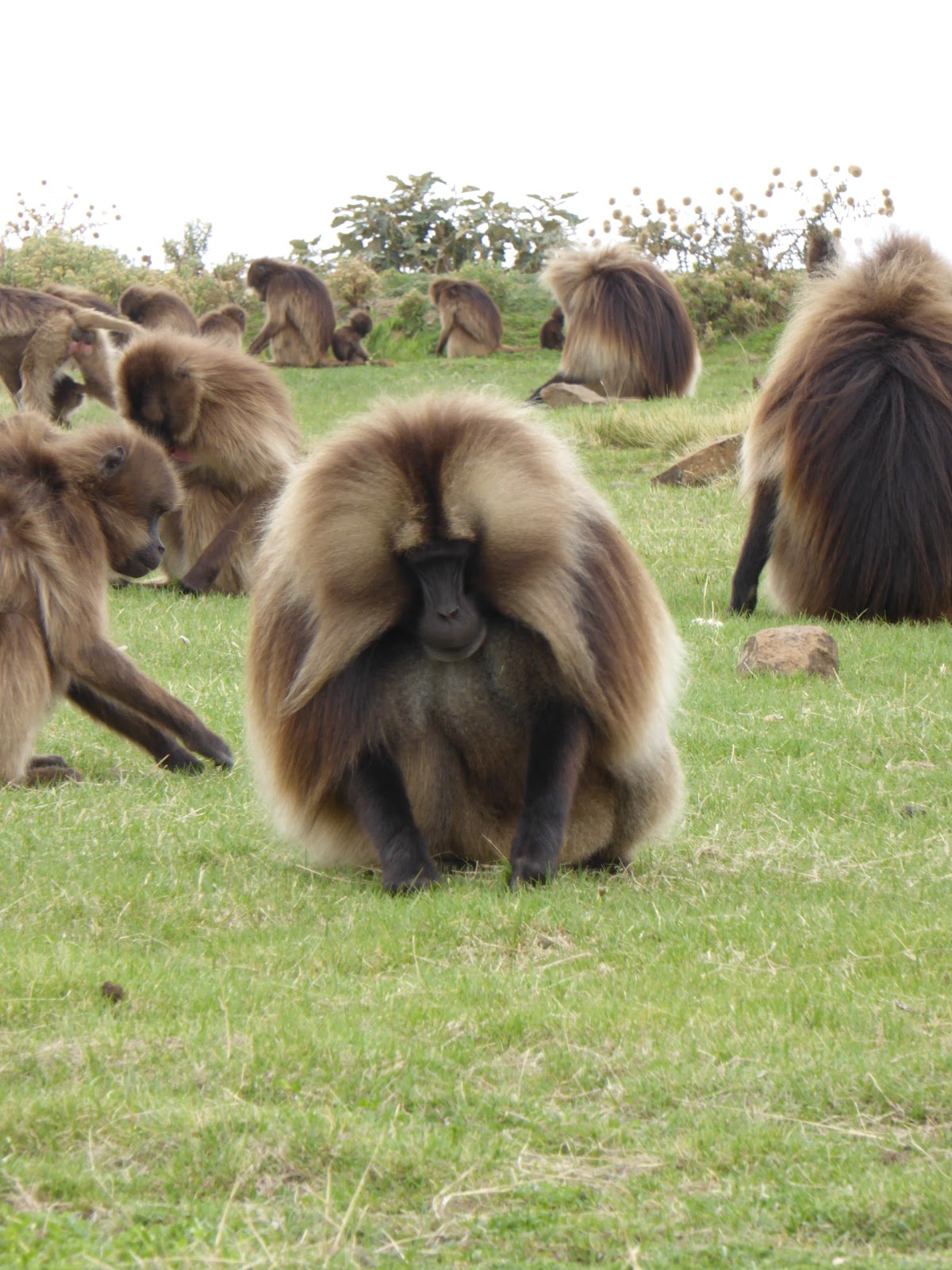
Just North of Gondar lie the beautiful Simien Mountains, with peaks reaching up to 4500m above sea level. It's a popular destination for overnight hiking, but sadly I only had time for a day trip. As well as stunning scenery, the mountains are home to some beautiful creatures, including two only found in Ethiopia; the Ethiopian Wolf (none seen sadly) and the Gelada Baboon  (lots seen!)


Our ranger

Klipspringer

Sitting amongst a troop of Gelada Baboons


Lalibela 
Lalibela was yet another of Ethiopia's capital cities - this time during the 12th and 13th centuries. Lalibela is often referred to as the 8th wonder of the ancient world, on account of its ancient and beautiful rock-hewn churches. It is also a place of pilgrimage for many Christians. 

There are 11 rock churches in Lalibela, constructed in the 12th century by King Lalibela, whose dream was to create a 'New Jerusalem'. Like the churches in Tigray, these too were carved out of rock, but in addition they feature connecting underground tunnels. 


Entrance to a pitch-black underground tunnel 
linking two of the churches 

Having been in Ethiopia for just over a week, I was beginning to understand that nothing about or in this country is ordinary. From the extreme, other-worldly natural landscapes of the Danakil, I had moved on to unique, beautiful man-made creations in the cities of the North. In both places the Ethiopian people have used their strength, determination and faith to make use of or transform the - often challenging - natural environment in truly inspiring ways.

From the North, it was time to head South and find out whether the bottom of the country had as many wonders as the top. But first, a quick stop in Addis...

:)
X

Saturday, 5 September 2015

10th May - 5th June: Ethiopia Part 1 - Danakil Depression

When I left the UK last September, my (very) rough plan was to 'travel from South Africa up to Ethiopia and then back down again'.  So, arriving in Ethiopia at the beginning of May marked an important point in my travels.  But much more than that, Ethiopia was a country that I had wanted to visit for many, many years and I was thrilled to finally arrive.

The reasons why I had wanted to visit Ethiopia so much are many, but include the following:
  • The Danakil Depression (see below)
  • Ethiopia is part of the 'cradle of humanity' - in other words, it is highly likely that the earliest humans came from this area, which makes us all a very little bit Ethiopian!
  • Ethiopia was one of only two African countries that were never colonized (the other being Liberia)
  • Ethiopia uses a different calendar from the rest of the world.  (This means that I left Kenya on 10th May 2015 and arrived in Ethiopia - a couple of hours later - on 2nd May 2007!)

After a couple of days in the capital city, Addis Ababa (more about Addis later), I was on my way to the Danakil Depression.

The Danakil Depression
The Danakil Depression is in the Afar region of Ethiopia, in the North-Eastern corner of the country, close to the border with Eritrea.  Danakil is often described as 'one of the most inhospitable regions in the world', being one of the hottest and lowest places on earth. Rain hardly ever falls in the Danakil and the only river that flows into the area ends up drying up and leaving just a chain of salt lakes, never finding its way to the Indian Ocean.  

The only way to visit the Danakil Depression is with an organized tour.  This is in part due to the remoteness of the region, in part due to the unresolved border dispute between Ethiopia and Eritrea, in part due to the potential for local tribal conflict and in part due to an international incident several years ago. (!)  As a result of the last three factors, all tours also have to be accompanied by 'local security' - in our case, 4 armed soldiers.

So I guess this doesn't sound like an ideal holiday destination to many of you...but it was one of the places on the continent of Africa that I was most desperate to visit, so I booked myself on a 4-day tour and set off into the dust and the heat!


My transport for the trip. The local goats quickly took advantage of the shade under our vehicle when we stopped at their village for lunch.


Sulphur and salt in the Dallol region
The Dallol region was our first stop on the tour. The region is home to some of the most surreal and beautiful landscapes, with vivid yellows and oranges, bubbling sulphur lakes, entire mountains made of salt and glistening crystalline salt lakes. It may be one of the most inhospitable places on earth, but i think it also probably one of the most visually striking.


The beautiful sulphur plains


A bubbling sulphur lake

Sadly many thirsty birds mistake the sulphur lakes for fresh water

Salt mountains


Two of our armed escorts - chirpy fellows!


Salt lake at sunset


Despite the hostile environment, the local people have found a way to survive here and to use the land to support themselves - by mining the salt.


Miners use axes to hack into the salt plains...


 ...before levering huge chunks up out of the ground.
 

The chunks are then cut into smaller blocks...


and loaded on to camels for transportation to the nearest town for sale.


On the day we visited the salt mines, our thermometer registered a temperature of 54 degrees Celsius (or 129 degrees Fahrenheit).  Stepping out of the car felt like stepping into an oven and it was a huge and intensely uncomfortable effort to walk the 50 metres or so to join the miners.  Watching the miners working relentlessly, without water or shelter, in the harshest possible conditions, was an incredibly humbling experience and one which I will never forget.

Our first night's accommodation - my bed is to the right of the door.


Erta Ale
Our next stop was Erta Ale. Erta Ale is a 'continuously active' volcano - one of only six in the world which have active lava lakes.  In fact, Erta Ale is the volcano with the oldest/longest existing lava lake, as it has been active and bubbling continuously since 1906. It's southernmost pit is known locally as 'The Gateway to Hell'.  Nice.

On our way to the volcano
  
We arrived at base camp in the late afternoon and were instructed to "rest" ahead of our climb.  Our climb was due to start at 5.30pm - the coolest part of the day - and to last approximately three hours, depending on our speed.  The climb itself, we were told, would not be that steep, but the heat (for the first hour before sunset) and then climbing over uneven and rocky ground in the darkness would be the biggest challenges.

So, at 5.30pm, we set off.  It was indeed the coolest part of the day.  It was 44 degrees Celsius...

There's not much to say about the climb.  It was hot, it was tiring and it hurt.  But, a gentle breeze provided some relief and the beautiful star-filled sky, a fat-tailed scorpion and an ever-brightening orange glow illuminating the horizon provided some distraction from the relentless stomp.

Finally at the top, we paused for breath and a safety talk (ish).  Our next hike was to be brief - and downhill - to the crater itself. 

I'm not sure I have the words to describe the mixture of achievement, excitement and terror that standing next to a bubbling lava lake made me feel.  It was the most surreal experience.  And the hottest!  The risk assessor in me was concerned that maybe we were all standing a little bit toooo close and the thrill-seeker in me was squealing like a small child.  It was both a thrilling and intensely unsettling experience!  And this is how it looked....


After an hour of watching the surface of the lake crack open and the lava bubble, spit and explode into the air, we made our way back up to the rim of the crater to sleep. (ha!

My cosy crater-side bedroom...

The following morning, we rose before sunset to spend some more time watching the mesmerising lava before beginning our tired descent back to base camp and a very welcome breakfast. We were all exhausted, but very proud that we had conquered the volcano. 

My fellow volcano-climbers - a lovely, lovely group of people


The four days I spent in Danakil were incredible.  They were physically, mentally and emotionally challenging and they taught me a huge amount about myself as well as about the power of the human spirit to adapt to and - mostly - overcome the most hostile of environments.  The experiences I had here and the people whose lives I was privileged to take a brief peek into will stay with me for ever.